


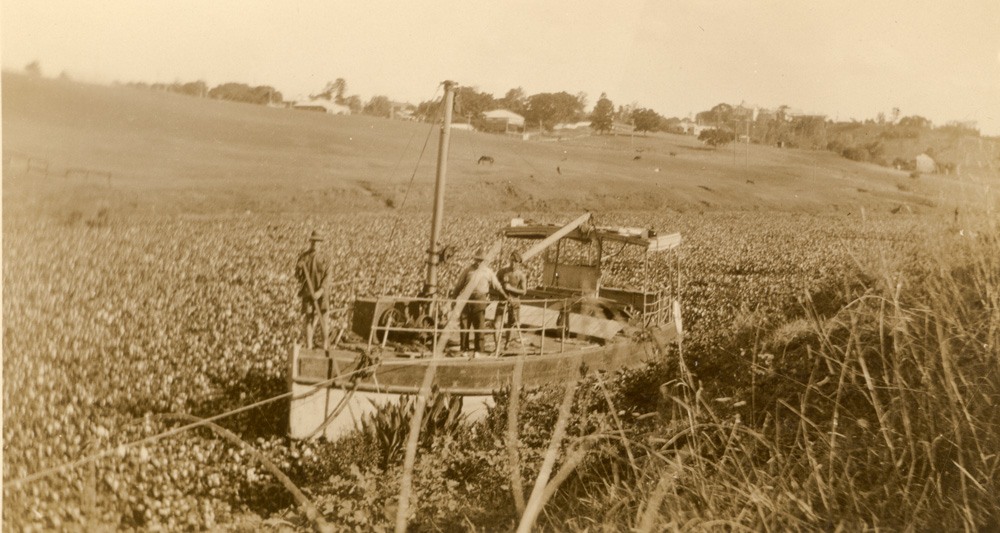
Hyacinth on the Bremer River, 1938 – Image courtesy of Picture Ipswich
In the early 1900’s hyacinth was a major pest on the Bremer River in Ipswich. The fast-growing weed infested the river with dense impenetrable mats and at its worst completely congested the river spreading from bank to bank, drawing river transportation to a standstill.
Hyacinth is a bulbous plant with pretty blue flowers and was originally brought to Australia as an ornamental plant from South America in the 1890’s. It was placed in the garden ponds of the Royal Botanic Gardens in Sydney where it rapidly spread. Pleas from a Government Botanist that the plant be kept away from rivers and areas of fresh water for fear it could become a serious pest went unheeded and the hyacinth plant rapidly spread from New South Wales up along the east coast of Queensland. When flooding occurred the hyacinth was swept out into other channels spreading along the way. Industry progress along Ipswich’s river banks had seen waste such as bones and spoils spilled into the river which created abundant levels of nitrogen, phosphorus and potassium; the perfect environment for the hyacinth to flourish and become prolific.
In December of 1900, hyacinth choked the Bremer River in raft size floating growths, some the size of a ‘bridge of foliage’ and in places reaching 4 ft. high. Patches of hyacinth reached from the southern bank of Bremer River as far as Lynch’s Crossing through to the Tivoli Bridge down to Moore’s Pocket and Waterstown, past the Bremer Mills onto Goodna and the junction. The Bremer River was used by steamers and other water vessels transporting cargo and people at this time and the hyacinth became a problem with propellers from some vessels becoming choked with the weed. When at its worst some boats and vessels became marooned for months as the weed became so thick and dense all navigation came to a halt.
The local ferry man, William Lawrence, who carried people across the river on his punt to and from North Ipswich and Basin Pocket, was known to place two cables across the river to hold the hyacinth back when it was overgrown so that his boat could cross the river. People were known to ‘walk on water’ as the weed became so thick in places it could carry an adult’s weight. They would cross the river walking on top of the hyacinth being ever mindful of the rats living in the weed. Children tied planks to their feet and played on the rafts. In parts of the river near Booval Butter Factory and the town bridge, booms were put in place to hold the hyacinth back so that steamers and other vessels could travel the river.
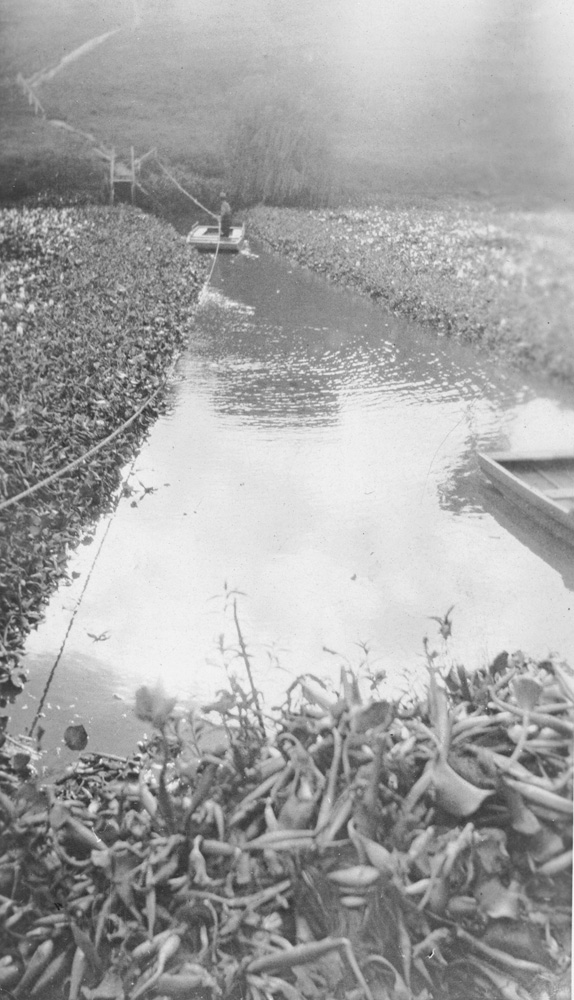
Cable was placed across the River to hold the hyacinth back – Image courtesy of Picture Image
The City Council communicated considerably with the Harbours and Rivers Board for help in clearing the river of hyacinth. A Mr H. Mitchell was placed in charge of an eight man group who came up the river from Brisbane on a large punt which served as their accommodation as well. As the weed came up the river with the tide it was hemmed in and held in place by logs and ropes at a point on the river bank above the town bridge. The men then hooked the weed dragging it up onto land for drying and then burning. By doing this the passage part of the river was kept open and clean.
In 1936, the Dredge Mourilyan was sent by the Harbours and Marine Board to lift hyacinth from the river to help feed starving stock. In times of drought hyacinth was fed to cattle as it was high in nutrients and cheap feed. The farmers would come down to the river bank and haul it by hook out of the river into the back of their trucks. This was an extremely serious outbreak of hyacinth weed with the river being choked from bank to bank, so a dredge was brought up from Brisbane to help with the clearing. The dredge Mourilyan hauled by the anchor launch Kookaburra had difficulty making its way through the thick weed to the city centre. At Booval the Dredge and Kookaburra could go no further and the crew had to pull the Mourilyan upstream along the bank, only able to go 300 or 400 yards before they had to stop. The work was slow but eventually the dredge forged a path to the city centre.
Eventually, the problem of Hyacinth in the Bremer River was improved with the help of relief workers, who were employed by the Department of Harbours and Marines to keep abreast of the problem; however it still remains one of the Queensland’s worst aquatic weeds.
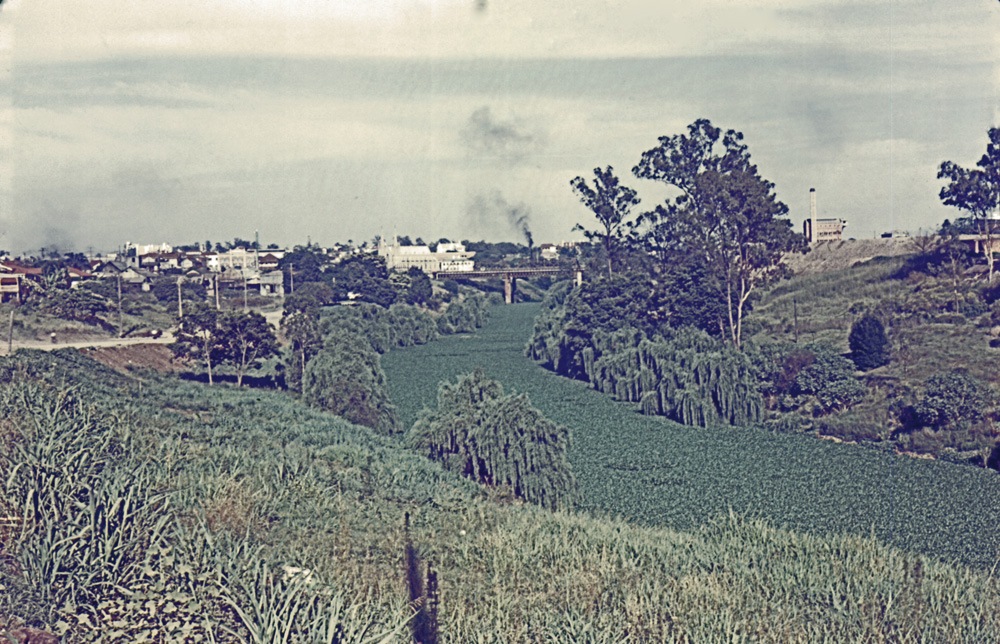
Bremer River, choked with hyacinths, ca. 1960 – Image courtesy of Picture Ipswich
Information taken from: NSW Department of Primary Industries; Water Hyacinth – weed of national significance, The Romance of the Bremer by Margery Brier-Mills, Ipswich in the 20th Century by Robyn Buchanan, The Courier Mail 10th July, 1935, The Townsville Daily Bulletin 23rd Nov, 1936