


White Rock is situated at the end of School Road, Redbank Plains, one of Ipswich’s oldest surrounding suburbs. White Rock today exists as a protected conservation estate and is also situated in close proximity to several other environmental landmarks of Ipswich including: Spring Mountain, Opossum Creek, Woogaroo Creek and Six Mile Creek. These areas are rich in local history with many pioneering families camping, picnicking, and trekking through the bush surrounding White Rock. Today a large proportion of this area has been preserved due to the significance of the flora and fauna species in the area and the unique riverine and dry rainforests that surround the local creeks in the White Rock Park.
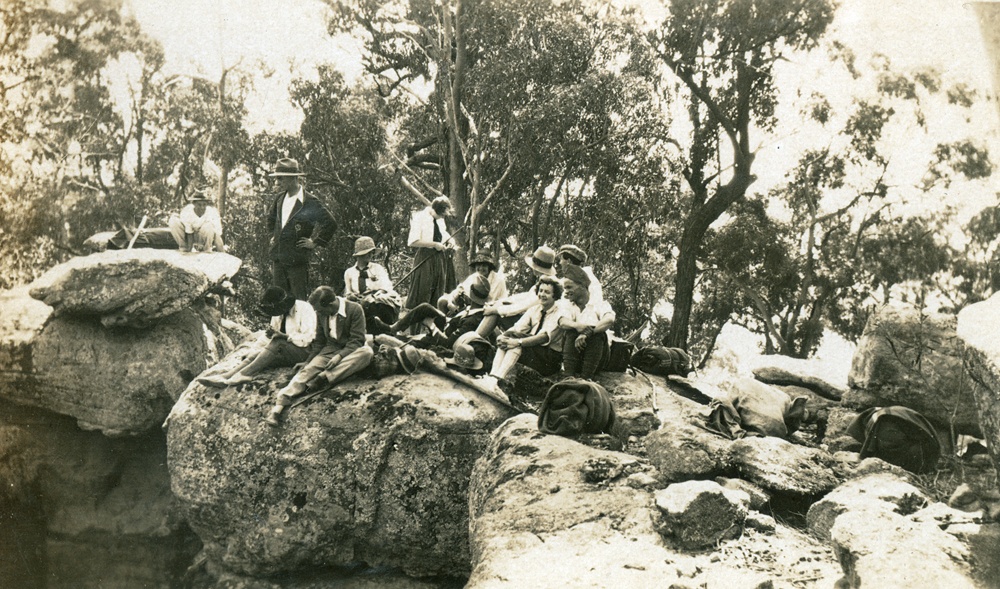
Members of the Jones family with friends, preparing for their trip home from White Rock, Spring Mountain, 1920s – Image courtesy of Picture Ipswich
Prior to its existence as a conservation estate White Rock was a heavily wooded area that had a number of valuable timber species including Red Cedar, Black Bean and Hoop Pine. When the suburbs of Goodna and Redbank Plains were settled it became clear that the timber here could become a great commodity in building the new cities of Ipswich and Brisbane. Logging soon became a serious problem in the area surrounding Woogaroo Creek as the industry grew and bushlands were cleared of the remaining natural environment. However, the area of White Rock did have one advantage in the fact that much of the area was covered in large vines and climbers including the Wonga Vine, Water Vine, Blood Vine and Knot Vine, all of which prevented loggers from accessing precious timber from this area.
Although logging of the White Rock and Woogaroo Creek area was common in the 1800s, many people both locals and out-of-towners, were still able to enjoy the natural beauty of the area, with several reports indicating thus: In 1889 it was reported that Queensland Herbarium naturalists with the assistance of the famous botanists F. M. Bailey and J. M. Simmonds, visited the Woogaroo Creek area on a field trip in an attempt to record and collect a number of the 29 plant species that existed at that time. As well as this group of naturalists, the area also played host to a famous botanist known as W. D. Francis who visited the area in the late 1920s and recorded three rainforest trees common in the area.
During World War Two and the Vietnam War the area around White Rock became a military training ground. In 1942 a number of gun emplacements were built in the area and used by American troops for training purposes. During this time many of the veterans carved their names into White Rock with their bayonets some of whom never returned to Australia after the war. After the area had fulfilled its duty as a training facility many of the trees could no longer be used for timber due to the large number of bullet fragments that now existed in their trunks, therefore logging ceased and the conservation of White Rock began.
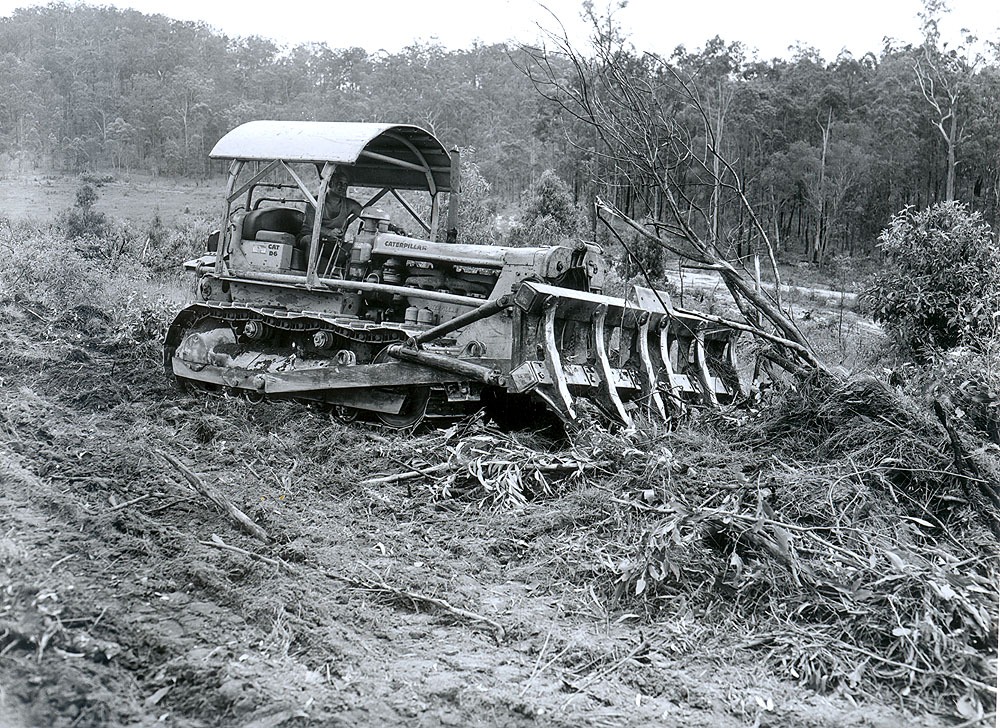
Opossum Creek, mid 1960s – Image courtesy of Picture Ipswich
In the early years many exotic tree and weed species were also introduced which later caused many problems with other native species in the area. As such many attempts were made to conserve and repair what was left of the scrub in this area, with the naturalist Lloyd Bird contributing a large amount of time to protecting the 200+ plant species in and around the area. During the early 1980s and 1990s a large portion of White Rock, Woogaroo Creek and Spring Mountain were purchased by the Ipswich City Council in an attempt to develop the conservation parkland that currently exists today. This area was chosen because of its particular importance in relation to rainforest flora, the endangered Eucalyptus Curtisii, medicinal plants and both the Woogaroo and Opossum Creeks importance to drainage within the bushland and their links to the Brisbane River. Today the White Rock – Spring Mountain Conservation Park is open to the public and offers scenic walking, horse and bike riding tracks, picnic shelters and a barbeque area. Relics of the past can still be seen at the lookout, etched into the rough sandstone that forms White Rock the names stand as a reminder of the history that this amazing natural formation has witnessed.
Information taken from: “Woogaroo or Goodna Scrub Woogaroo and Opossum Creeks Goodna: comments of the early history and present day flora”, Woogaroo Scrub Project preserving flora and fauna for future generations”, “Battlefield worth preserving” (QT 28/01/1991), “White Rock brings back memories” (QT 22/01/1992), “The Picnic Tree” by Lloyd Bird, “Opossum Creek save the bush project”.