


The area of Hidden Vale was first settled in 1841 and formed part of Franklyn Vale. During this time the area of approximately 384,000 acres was used by Henry and Maria Mort to farm sheep. However, after separation the new government saw fit that the large area of Franklyn Vale be divided up and leased to other colonists. In 1871 after the area was divided 10,000 acres of this land was taken up by a Mr John Phillip Jost and his wife Catherine Lahey. Mr Jost, who had immigrated from Germany and previously owned a butchery in Brisbane, established himself on the property by constructing a small hut and proclaiming the area Jost Vale. Jost Vale, which was an area of land situated in the Liverpool Ranges, was used to breed a range of cattle, sheep and at one point race horses. In 1900 after living at Jost Vale for close to 20 years John and Catherine sold the property to a Mr Alfred Cotton.
Alfred Cotton was a well-travelled seaman and drover with many wonderful life stories to tell by the time he finally purchased Mr Josts’ land. After moving into the small slab hut with his wife Annie Bode and their daughter Lillian May, Alfred Cotton changed the name of the property to Hidden Vale. According to reports the name may have been derived from the spectacular view which took any person travelling through ‘by surprise’. Prior to purchasing his Hidden Vale property Mr Cotton had several other highly successful cattle stations in Queensland. Therefore it is with little surprise that shortly after moving in with his family, he established a short-horn bull breeding stud.
During their time at Hidden Vale Alfred erected the first two-storey structure in 1908 on a small plateau on the property. Over the years the property was added to a number of times with the inclusion of a number of out buildings, carriage and motor sheds, stock yards and bull pens. Little is known about who was commissioned to construct these buildings however the most significant of these was the Chinese Room which was Mr Cotton’s office. This building, which still stands today, is a square timber structure with a pitched roof. In 1919 having lived in the house with his family for some years the homestead was burnt down in a vicious fire that claimed all but the detached kitchen. After this devastating fire the Cotton family held onto the property for a number of years before selling to the Day family in 1929.
Unfortunately, little is known about the time Hidden Vale spent in the hands of the Day family, except that they changed the homestead name to Sutton Royal. In 1938 the Day’s sold the land to Mr Murdo MacKenzie and family. After purchasing the property Mr MacKenzie decided to rebuild the main homestead into a single storey dwelling, which ended up being approximately 190 feet long. Mrs MacKenzie was not impressed with these improvements and as a result the structure was demolished and rebuilt to suit the family’s purposes. The replacement homestead was a beautiful building with verandas on all sides and grand views of the property gardens and Cunningham’s Gap. Murdo MacKenzie maintained the tradition of Alfred Cotton upon buying the land and he became the first grazier to introduce Bos Indicus cattle into South Queensland. In 1964 after the death of Mr Murdo his two daughters carried on the business of the Hidden Vale property and in 1964 they managed to purchase back the 1000 acres that was originally lost from the Jost family sale in 1871. Today the Hidden Vale homestead and land stands as testament to the early rural settlers of the Franklyn Vale area.
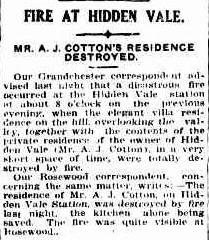
Article form the Queensland Times Newspaper detailing the fire that occured at the Hidden Vale Homestead in August of 1919 – Courtesy of Trove Digitised Newspapers.
Information taken from ‘Moreton Shire Queensland: Discovery and settlement’ by Joan Starr ; ‘The Expanded Ipswich Hertigage Study’ compiled by The Ipswich City Council ; ‘History of Queensland’ by Matt J. Fox.