


In 1932, as an addition to his trucking business, Percy Manders purchased a 40 foot cargo vessel from Foggitt Jones Pty Ltd and began operating a regular transport service between Brisbane and Ipswich. This vessel, Eclipse, carried 18-20 tons of mixed cargo and made three return trips each week. Four years later, Percy acquired another vessel which he named Bremer (formerly known as Cowslip). The Bremer was powered by a three cylinder Palmer engine and had a load capacity of 25 tons.
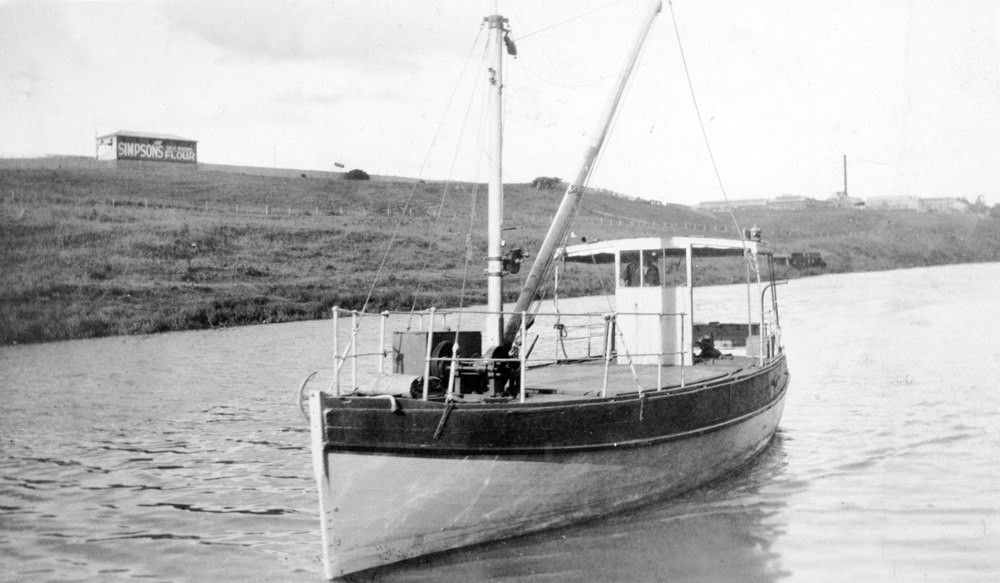
Eclipse (boat), Bremer River, Ipswich 1936 – Image courtesy of Picture Ipswich
As recalled by a former crew member, each vessel carried a crew of two and departed Ipswich early in the morning on alternate days. The trip to the Short Street wharf in Brisbane took around four hours with the cargo unloaded upon arrival. While the crew were normally ready to depart back to Ipswich by 4pm they regularly had to wait hours for the proper tide conditions to ensure they could navigate past Seventeen Mile Rocks.
Traversing the Bremer and Brisbane Rivers was challenging and skippers were dependent on landmarks. Percy compiled a set of navigation instructions with directions like, “keep on starboard bank for about a mile, look out for a board nailed on a large gum tree right at the water’s edge, this gum has a large boulder at its base; cross the river here at an angle of about 45 degrees…” Adding to the problems of navigation were the regular floods and shifting river shoals.
Unfortunately, in 1938 the fully-loaded Eclipse ran aground on a sandbank at the Brisbane end of the swing-basin. Once the Eclipse was re-floated, it was towed by the Bremer to a sandbank on the north bank across from the Roseberry Parade wharf, where temporary repairs were undertaken at low tide. The Eclipse’s engine required significant maintenance which ultimately proved fruitless – during the engine’s trial run it backfired, caught fire and totally destroyed the vessel. Consequently, additional cargo boats – including Regina, Gold Crest and Kauri – were hired as needed.

Remains of Percy Manders’ Eclipse (boat) – Image courtesy of Picture Ipswich
With the arrival of World War II, the Navy requisitioned the Bremer and used it to transport equipment to a port located at Cowan Cowan. The vessel was also employed to bring soldiers back to Brisbane on leave. With Bremer out of service, the Kauri continued the cargo service. Once the war ended though, cargo-bearing trucks were allowed and this quicker type of transport spelled the end of the river service.
In 1946, Percy purchased a vessel that was originally intended for war service. This 46 foot vessel, which he named Srednam (Manders backwards), was one of many that were left unfinished by the Government following the end of the war. Percy had initially offered £1000 for the vessel but due to problems with the tender process, it was ultimately auctioned. As a result, he managed to acquire the Srednam for £400. Percy converted the Srednam into a private launch and it was licensed to carry passengers along the Brisbane and Bremer rivers, primarily on outings to places like the Junction and Lone Pine. In 1955, due to the obligations of the trucking business, the passenger service ceased. The Srednam was then used for private purposes by Percy and the family before being sold in the mid 1970s.
Srednam(boat), at The Junction, Bremer River, Ipswich, 1948 – Image courtesy of Picture Ipswich
Information taken from: The Romance of the Bremer by Margery Brier-Mills; The Bremer River by Robyn Buchanan; Ipswich in the 20th Century by Robyn Buchanan.