


On Saturday the 9th of May from 10.00am – 3.00pm for a cost of $5.00, the National Trust of Australia, Queensland branch will open the doors to some of ‘The Great Houses of Ipswich‘. In past years houses chosen have included Rockton, Bowerlea, Fairy Knoll and Claremont II. This year the National Trust will be showcasing three famed Ipswich houses:
Lakemba – 14 Chelmsford Avenue, Ipswich
The Chestnuts – 90 Nicholas Street, Ipswich
Karragaroo – 8 Karragaroo Street, Eastern Heights
In preparation for this event, why not read up about each of these houses’ history, heritage and the families which once inhabited them. We have compiled some basic facts for your convenience:
Lakemba, 14 Chelmsford Avenue, West Ipswich
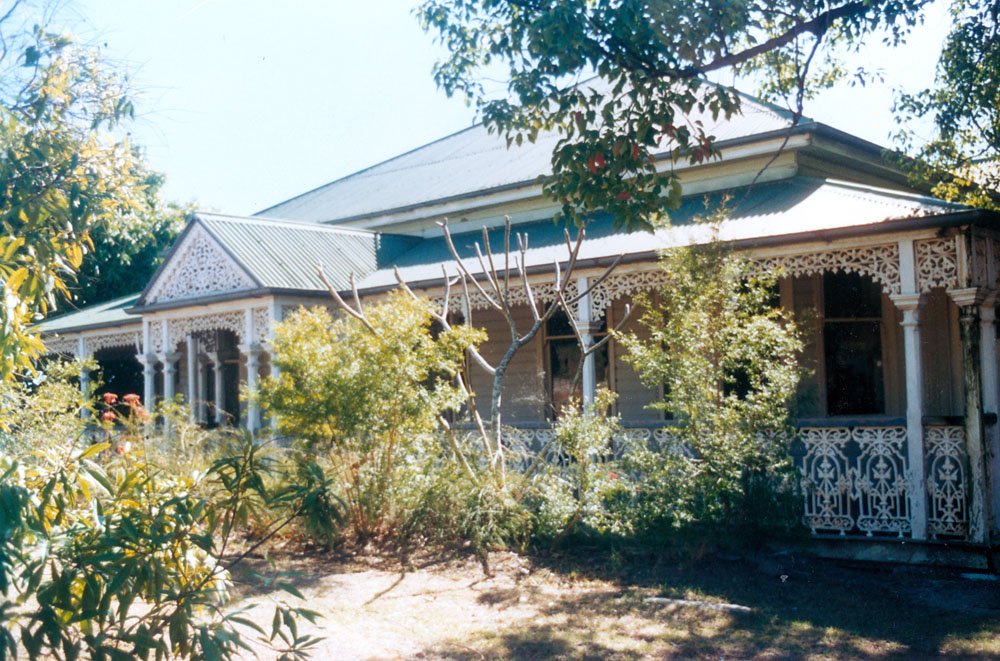
“Lakemba”, 14 Chelmsford avenue, 1991 – Image courtesy of Picture Ipswich
A timeline of owners and buyers through the years –
The land on which Lakemba stands was originally purchased by Charles Samweays Warry in 1861.
In 1885 the land was valued at 16 pounds and was owned by George Rennie Wilson.
Mr Rennie’s son, Victor, was then transferred the land.
In 1901 Victor sold the land to builder William Betts.
The land was then transferred to Mr Betts’ wife, Isabella Betts.
In March 1902 a house was erected on the land.
The house was purchased in 1920 by Mary Calvert Horsley and in 1936 by Alan Bridson Cribb.
Distinguishing style attributes –
Lakemba is a Federation era house (c1890-1915) – this is a style that originated in England as the Edwardian style but was adapted by Australia when we became a nation in 1901. It includes styles such as the Federation Queen Anne, Federation Arts and Crafts, Federation Bungalow and the Federation Filigree.
It has a corrugated iron roof that includes separate roofing for the verandah, which appears on three sides of the house.
Lakemba includes such decorative features as filigree lace cast iron balustrades, a gabled portico, intricate timber fretwork and timber support posts with moulded capitals.
Chestnuts, 90 Nicholas Street, Ipswich
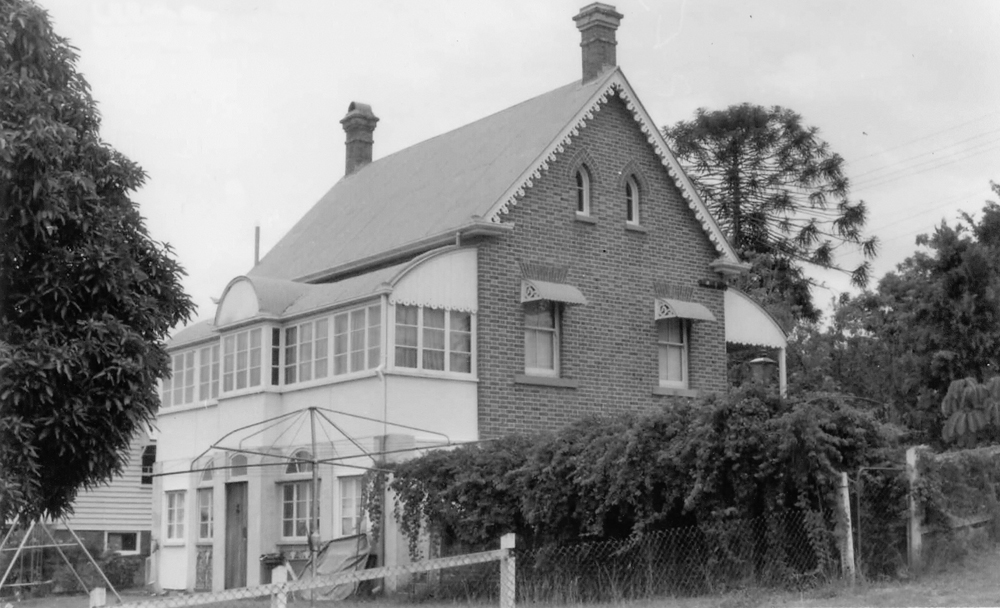
“Chestnuts”, 90 Nicholas Street, 1972 – Image courtesy of Picture Ipswich
A timeline of owners and buyers through the years –
In 1858 Mr T.B. Lyons, an Ipswich watchmaker with a shop in Brisbane Street, purchased the land on which Chestnuts now stands for 75 pounds.
The land at this period was a corner block which occupied Court Street and extended to Meredith Street.
A brick house was built on the lower side of this land by Mr Lyons c.1863 and was known as “Mona Lodge”.
From 1873 “Mona Lodge” was rented by Mr Lyons to Mrs Mary Darnley Morrison who used the house as a private school. Mrs Morrison was born in Scotland and moved to Australia in 1866 with her daughter Mary, after the death of her husband. Her first private school was opened in Rose Cottage in Roderick Street. Mrs Morrison’s daughter later grew up to teach music at her mother’s school and also taught dance classes in Ipswich’s local halls.
Later on T.B. Lyons subdivided the land and built a second house, on the higher section of the block in 1885.
In 1885 Mary Darnley Morrison purchased both Mona Lodge and the new house, which she called Chestnuts, from Mr Lyons.
Chestnuts operated as a finishing school until the turn of the century.
Mary Morrison lived in Chestnuts until her death in 1928 and her daughter continued to live here until 1937.
In 1937 the Peters Family purchase Chestnuts and later during World War 2 the house was purchased by Mr S. Hancock.
Distinguishing style attributes –
Chestnuts was designed by Mr J. Mackenzie.
It is a three storey double clinkered plastered brick building. The bricks originally formed a puzzle pattern on the building.
The original design consisted of an attic room and a basement.
The house has a front and back verandah, which features cast iron balustrading.
The floors and walls in Chestnuts are triple bricked, with the floors being made of Queensland red cedar wood. While the doors and fireplaces are made of cedar wood.
Chestnuts has a large attic room which, in previous years was accessed by a folding ladder. At either end of the attic room can be seen small gothic revival style windows.
From Chestnuts lounge room a staircase leads down to dining room, kitchen, bathroom and laundry
Over the years the house has been renovated numerous times, however major renovations and changes took place in the 1960s and 1970s. During this period the verandahs were rebuilt and a spiral staircase was added to access the attic.
Karragaroo, 8 Karragaroo Street, Eastern Heights
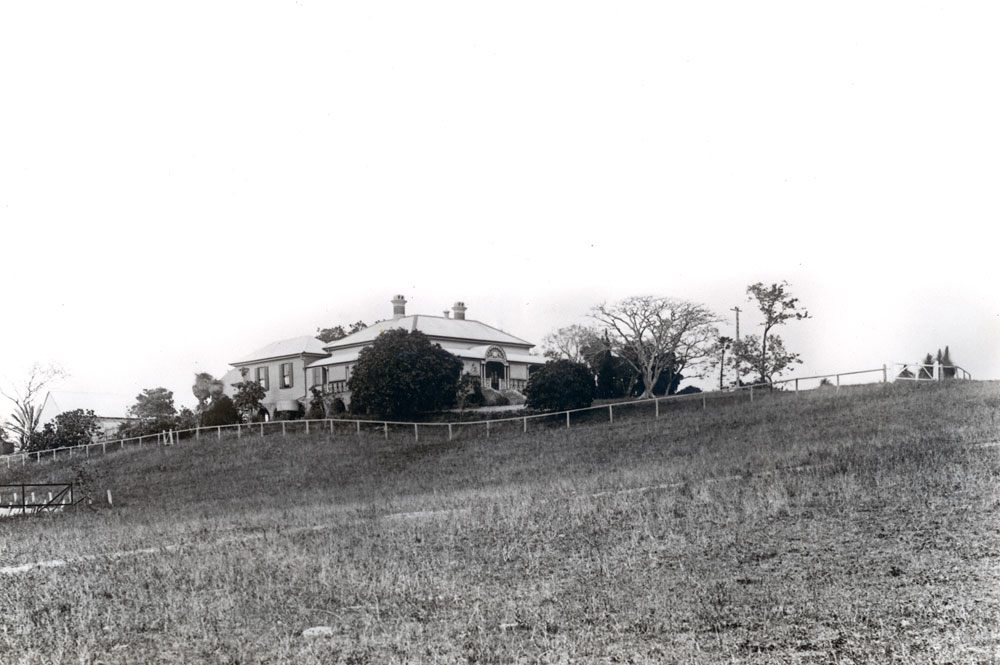
“Karragaroo”, 8 Karragaroo Street, c1920 – Image courtesy of Picture Ipswich
A timeline of owners and buyers through the years –
Karragaroo was built in 1883 for Mr Ambrose Foote who was the son of John Clarke Foote and the partner of Benjamin Cribb of the Cribb & Foote Department store.
The house was located on a huge block of land, which was thought to be one of the highest areas in the town at the time.
In 1919 the house and land was sold to F.A. Whitehead who was a well-known Ipswich photographer at the time.
After purchasing the house the land started to be subdivided by the Whitehead family and the site on which Karragaroo stood became smaller as the years progressed.
In 1943 after the death of F.A. Whitehead the house has had numerous owners and renovations.
Distinguishing style attributes –
On being first built in the 1880s Karragaroo, which is a brick construction, contained approximately 20 rooms, which is just as well, as Ambrose Foote’s family had six sons to house.
Karragaroo is thought to be an indigenous word meaning: the place of grass trees.
Karragaroo also contained a garden that was terraced on three levels, and was kept in good order by Ambrose Foote, who was a very keen gardener. The land also had a number of Moreton Bay Figs, Orange trees and Custard Apple Trees.
During this period the water used for laundry and bathing was supplied by the well on the Karragaroo grounds and the lights were run by gas.
The house also had a number of stables, which housed the horses and the four-wheeled buggy used to transport Ambrose Foote’s family to the Methodist Church every Sunday. However, these were later converted into a garage and a tennis practice room by the Whitehead family.
The shape of the building is rectangle but extends at the back to incorporate three corrugated extensions.
The roof contains an interesting cylindrical ventilator decoration as well as three corbelled chimneys.
The verandahs, which had previously been enclosed, now wrap around the whole of the front portion of the house.
If you are interested in visiting or learning more about any of theses three beautiful houses, then why not take a trip to Ipswich on Saturday the 9th of May. You’ll have a chance to step back in time and view thee majestic houses in near original condition. For more information visit the National Trust website.
Information taken from: “Karragaroo – The place of the grass trees” (21/09/1966); Ipswich Heritage Study 1992; Ipswich: views from the verandah by Robyn Buchanan and David Phillips; Register of historic house and property names in Ipswich by the Ipswich city council; “House delights tourists” (29/11/1985); “The Chestnuts – where young Ipswich learned to dance” (15/02/1967); “Stunning history is awesome” (07/09/2013).