


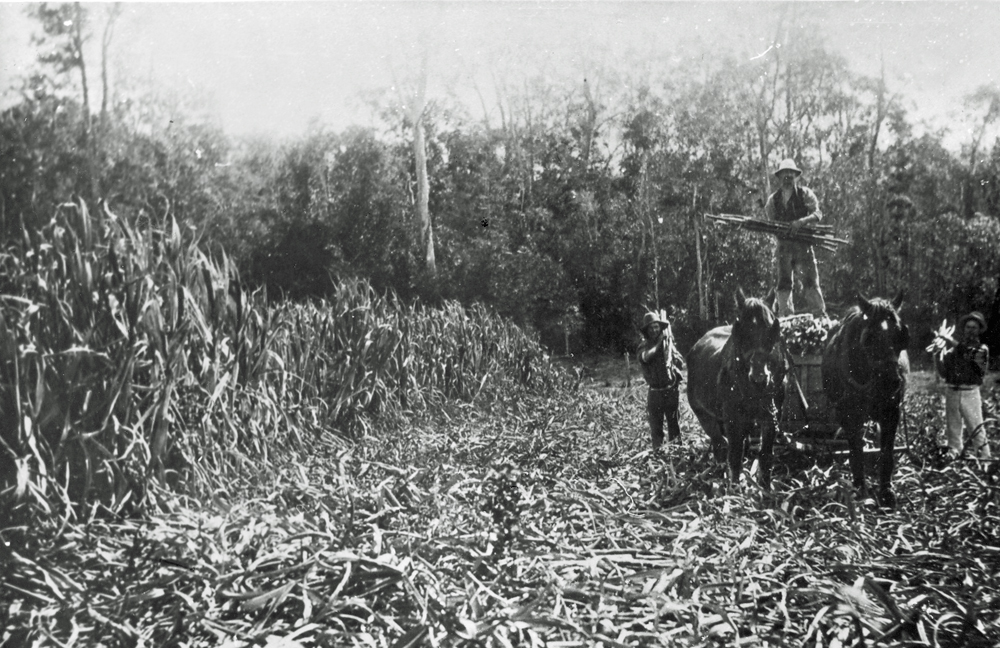
Charles Smith came to Australia from England in 1864 and resided with his family in Ipswich for two years before they relocated to the Marburg area. Between 1866 and 1870, Charles acquired hundreds of acres of land in the Walloon Parish and in September 1870, he bought the “Woodlands” selection which consisted of 568 acres. Around 1877, he moved his sawmill from Sandy Creek to the western end of this property and although the mill burnt down three years later, it was promptly rebuilt. As local timber resources became depleted in the 1880s, Thomas Lorimer Smith, Charles’ son, decided to plant sugar cane on the property and subsequently constructed a sugar mill adjacent to the sawmill.
The Woodlands mansion, which still stands today, was designed by well- known local architect George Brockwell Gill and Joseph Klee is believed to have been the person responsible for the interior work. The bricks used in this Italianate style building were made locally at a site in either Marburg or Black Snake Creek. This elegant two-storey home included a sandstone cellar which was used to house the wines made from grapes grown by Smith on the estate. Thomas and his family moved into the mansion in July 1891 and the property remained within the family until it was sold to the Order of the Divine Word in 1944.
Once the property was sold to the Order, it was used as a recuperation centre for their missionaries that had been evacuated from Papua New Guinea during the Second World War. Residents from the local area helped the priests and brothers to restore the home so it would also be suitable for a seminary and two other buildings were constructed to be used as classrooms and dormitories. Woodlands was renamed the “St Vincent’s Missionary Seminary” and in 1945 eleven men entered the seminary to commence their missionary training. Sunday Mass was held at the Seminary for over 40 years and the links were strong between the people of Marburg and the missionaries.
In 1986, the Divine Word Missionaries were forced to sell the property due to the rising costs associated with maintaining the old building and land. It was purchased by the Ipswich Boys Grammar School and was used to run personal development courses and other activities. During the sixteen years the School owned the property, the missionaries’ chapel was transformed into a dining room and an accommodation block was constructed to house bigger groups. To support the ongoing maintenance costs of the property’s buildings and grounds, the school hired out Woodlands to corporations for retreats and team building activities.
By 2002, the Ipswich Boys Grammar School decided it no longer needed the property and it was sold to a well- known local family, the Coopers. They set out to restore the estate to its former glory and have since opened up Woodlands to the public. These days the grotto and chapel on the grounds are used for wedding ceremonies and there are also facilities to accommodate individual dining, receptions, conferences and meetings. Around Woodlands, grape vines continue to flourish as do a variety of fruit and nut trees, some of which were planted by Thomas Smith. Woodlands remains one of Marburg’s oldest and most treasured properties and stands as testament to more than 100 years’ worth of history.
Panoramic view of Marburg district from Woodlands, Marburg, Ipswich, 1907
Information taken from : “Expanded Ipswich Heritage Study. Volume 2, [Marburg, Rosewood, Rosevale areas]/prepared for Ipswich City Council by Buchanan Architects; The bush chapel, Woodlands of Marburg : the final resting place of a neat little church; St Vincent’s Seminary 1944-1986 – A tribute to an era; Woodlands of Marburg – http://www.woodlandsofmarburg.com.au/.